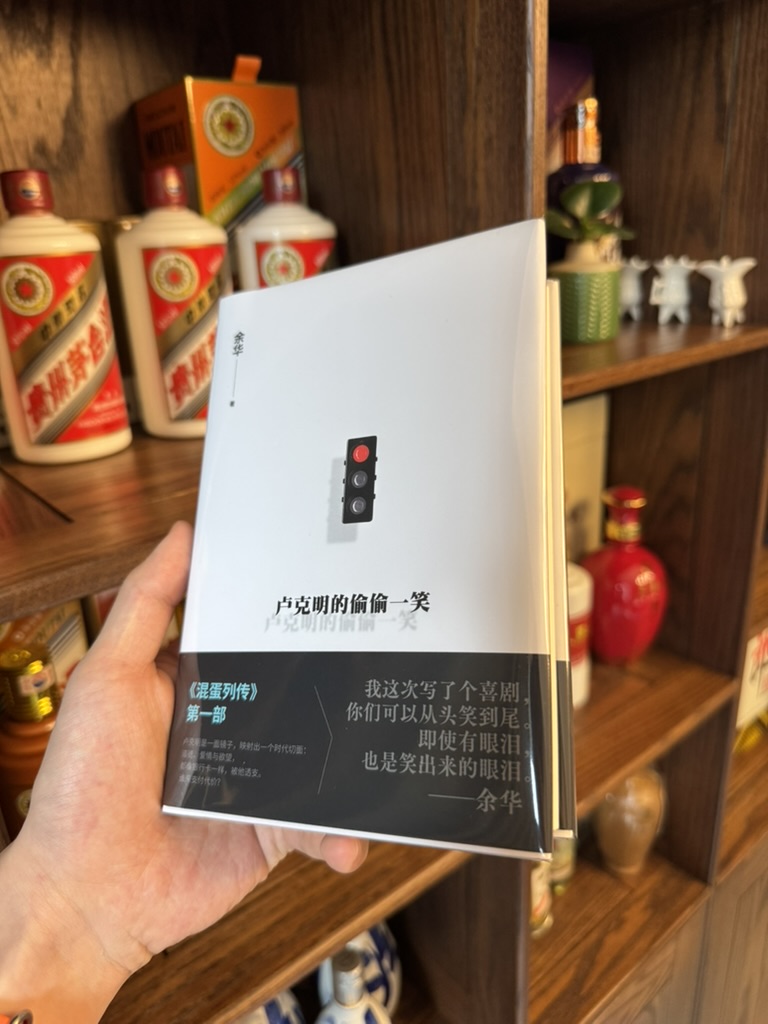
You don’t need to put much thought into reviewing Yu Hua’s Lu Keming’s Secret Smile, because Yu Hua didn’t put much thought into writing it either. I’m joking, of course. No offense intended to either myself or Yu Hua. Forgive me, dear self. And you too, Yu Hua.
The book has drawn more criticism than praise. I think the controversy comes down to the story it tells and the explicit language Yu Hua uses to tell it.
It follows a bastard named Lu Keming, who goes from being the unremarkable owner of a small renovation company to a man worth hundreds of millions, thanks to his friend Jin. Lu Keming is a bastard through and through, guilty of countless unforgivable wrongs in both his personal and professional life. Yet by the end of the book, things have worked out extraordinarily well for him.
I think the story itself almost invites readers’ disapproval. Why? Because life goes far too smoothly for its protagonist. Readers don’t like it when everything goes a good person’s way, because it seems absurd. When everything goes a bad person’s way, they like it even less, because that makes still less sense.
We tend to believe that good people get their rewards and bad people get what’s coming to them. But the fact is that plenty of people do terrible things and end up living lives others envy. I think Yu Hua’s purpose in writing his series about bastards is to remind us how absurd and unfair our society is. Some people do a great deal of good, only to be slandered; others do a great deal of harm and get away with it.
Who, then, is the good person in this book? Lu Keming’s wife, Lan Ying. I felt sorry for her many times as I read. She looks after their son on her own and asks few questions about her husband’s business. When his company gets into trouble, she reminds him to take care of his health. All the while, she has no idea that he has kept numerous mistresses. Yet in her own mind, Lan Ying is happy. What you don’t know can’t hurt you, as the saying goes. We readers pity her because we know more than she does: we know what her husband is really like. Lu Keming represents a certain kind of person in our society, and so does Lan Ying. He is a scoundrel, but he lives without a care. She is a good person, but the happiness she feels rests on an illusion.
I’ll leave you with one more thought about good people and bad people. In his book Ah, People!, Mo Yan tells a short story that ends with this line: good people and rotten people both drive society forward, and sometimes the rotten ones play an even bigger “part” than the good.
Beyond objections to the story, I’ve also seen many readers say that Yu Hua’s explicit language makes them uncomfortable. But there is a philosophical question here: aren’t Lu Keming’s thoughts the very thoughts that some people in the real world have? I think they are. What goes through the minds of real-life creeps is probably several levels worse.
I don’t think the filth and vulgarity are simply the author’s choice. He is bringing the darkness of society itself before a wide readership through words. Reality deserves to be seen, not condemned for being shown.
This isn’t an outstanding book, but it isn’t a waste of time either. At a little over a hundred thousand Chinese characters, it’s something you can pick up when you have a few idle hours and enjoy the ride along with Lu Keming. Just be sure to leave his behavior on the page.
要政阳
September 7, 2026, Beijing