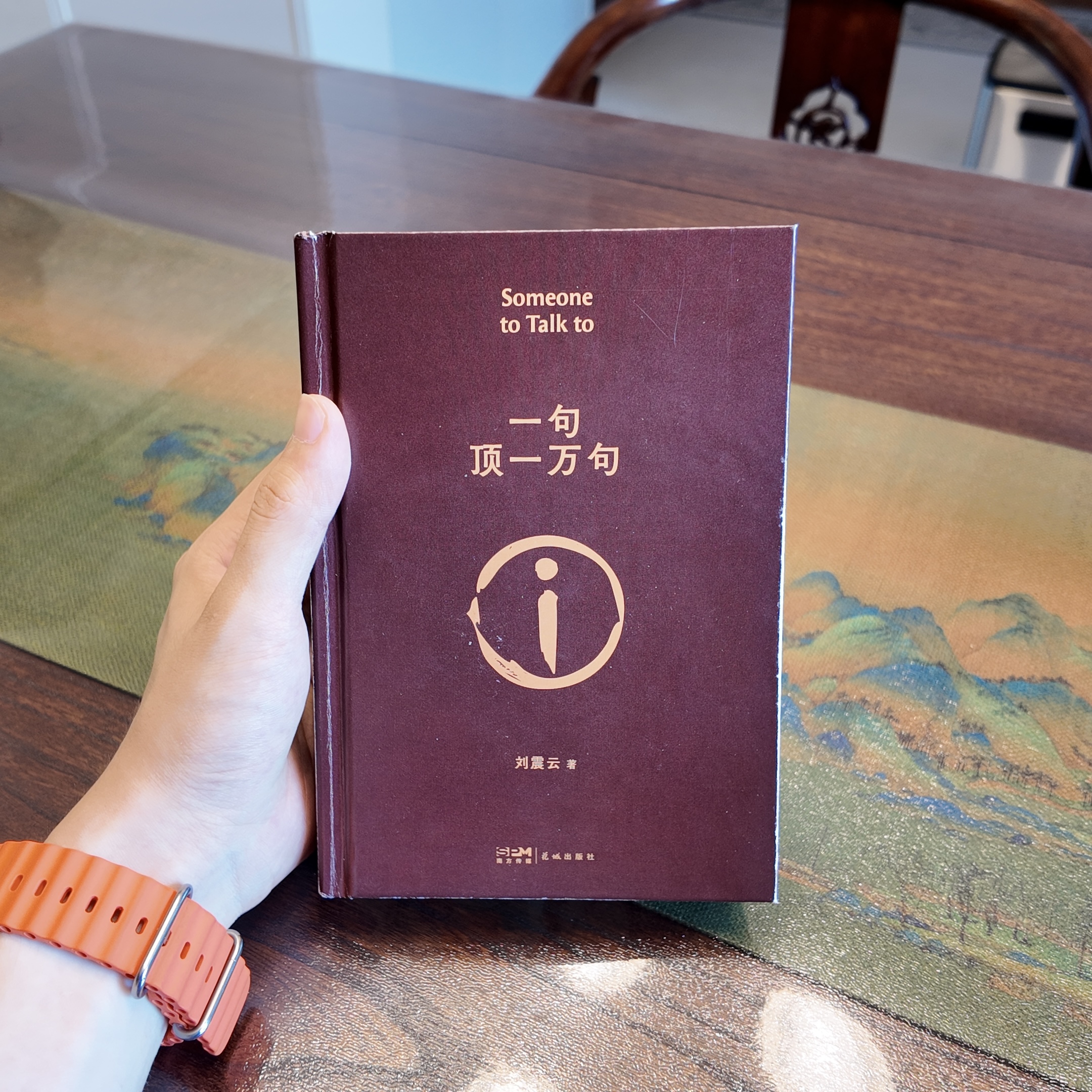
I first came to know Liu Zhenyun through podcast episodes on Bilibili. I found I could actually take in what he had to say, so I went and bought Someone to Talk to. It’s a book about whether people can ever truly talk to one another — and the reason I picked it up was exactly that: having listened to his podcasts, I found that even through nothing but audio, he was someone I could talk to.
Right from the opening, through the story of two men, Liu Zhenyun lays out all the petty frictions between people with perfect clarity.
Old Yang the tofu seller won’t necessarily hit it off with another tofu seller, and Old Ma the cart driver won’t necessarily hit it off with another cart driver. And even when two people do seem to hit it off, it may be nothing more than wishful thinking on one side. On the surface they get along fine, yet behind Old Yang’s back that cart driver mocks him to other people — while Old Yang still believes Old Ma holds him dear in his heart. If you want to know what a stab in the back is, this is it. Two people who look perfectly warm toward each other, and neither knows who is sharpening a knife for whom behind the scenes. The one who knifes you from behind is far more frightening than the one who comes at you head-on. What’s scary isn’t that someone harbors bad intentions — it’s that you have no idea.
Choose your friends carefully. Never pass judgment on a person’s character after a few exchanges of words; only time reveals someone’s true face. In business this matters even more. My father once told me that in the business world, it often takes three to five years to judge whether someone is fit to be a partner. If that’s true of friendship, it’s truer still of marriage, where there is no room for carelessness at all. Choosing someone to spend your days with is the business of a lifetime. Two people must not only be drawn to each other physically; their souls must answer each other. Plenty of couples can share a bed yet have nothing to say. Having nothing to say is a terrifying thing — two people who see each other morning and night, with no words between them, end up holding everything in, and that breeds a tangle of other problems. How do you judge whether two people can talk? First, I think, there must be common ground — shared topics are what keep the conversation flowing without end, so you never exhaust everything the other person doesn’t know and run out of words. You can strike up a conversation with any stranger, but given enough time, once everything sayable has been said, if there is no common ground to sustain it, the words simply run out for good. Second, there must be mutual respect. Every person is unique and carries thoughts of their own. Allow your own opinions to be overruled, and open your heart to the other person’s position and point of view. Don’t make decisions alone; listen to their opinions and suggestions. Take a genuine, heartfelt interest in what the other person talks about — only then will they be willing to listen to what you have to say. Different temperaments are nothing to fear, and different hobbies even less so. As long as both people respect each other, two different people can strike bigger, more beautiful sparks together than two people cut from the same cloth. Two people with the same temper can’t make a life together; it usually takes two opposite tempers for the days to run smooth — and to stay interesting.
The plot of the book is vast and intricate, yet rigorously structured. It comes in two parts: the first, “Leaving Yanjin,” follows Yang Baishun; the second, “Returning to Yanjin,” follows Niu Aiguo. The two halves are tightly joined, the plot interlocking link by link. The web of characters looks complicated but unfolds naturally — read with care, it never feels tangled, and nearly every page drives home the same point: finding someone you can truly talk to is a terribly hard thing.
The people in the book, every single time, find a friend they can talk to — and then are pulled apart by one circumstance or another. It may be years before they can talk again; it may be that they brush past each other and are lost to one another for the rest of their lives. Or a misunderstanding or a lie shatters, in an instant, a bond that seemed unbreakable, beyond all repair. Liu Zhenyun likes to describe truth and lies this way: while the truth is still putting on its shoes, the lie has already traveled the whole world on the internet. Many relationships in the book break precisely on a misunderstanding. This left me with four reflections.
First: two people who spend every day together, however much they have to say, will eventually say it all. Learn to leave each other personal space and time; the right amount of distance is what helps both sides preserve that state of being able to talk.
Second: realize how extraordinarily precious it is to meet a friend you can talk to. We need to treasure the confidants we find — but we cannot depend on them entirely. Learn to respect them: when you come, I talk with you; when you suddenly cut contact, I hold no grudge. The world is full beyond counting of people who love each other, but two people who can truly talk are vanishingly few. Money cannot buy back time, still less a true friend. Never bind yourself to another person through worldly interest; let genuine warmth and care be the bond between hearts.
Third: say things clearly. Human language is a blurry thing. Two people can hear the same sentence and take away two different meanings — and if the meaning gets twisted toward the negative, nothing good follows. Ask until things are clear before you decide; sometimes the other person meant nothing by it, and meant no harm at all.
Fourth: deal with each matter on its own terms — don’t let one thing drag in another. When the people in the book talk, one matter often pulls in three or four others; a single sentence, wound around and around, shifts meaning several times over, and the whole affair grows more and more tangled.
Meeting a true friend is hard. In an age when the internet lets us meet people across the whole world, it ought, by rights, to have gotten easier — but in fact the whole business has only grown more complicated. Our address books are far thicker than they used to be, but thicker is all they are; it doesn’t mean our ties to others run any deeper. Surface-level conversations play out every day, while a helping hand at the moments that matter is scarce as ever. The internet has put “meeting” within arm’s reach — and in doing so has made real, face-to-face meeting feel less worth treasuring. At bottom, the internet made making friends easy, and so we stopped treasuring the friendships we already have.
While I was reading this book, I posted much less to WeChat Moments. Partly it was because I caught a cold and my daily rhythm was temporarily thrown off; partly it was because of the book itself. I used to read its Chinese title — literally, “one sentence tops ten thousand” — as meaning that one kind word outweighs ten thousand unkind ones. Only later did I learn what it really means: one sentence spoken with someone who understands you is worth ten thousand spoken to someone who doesn’t. Sometimes no words are needed at all — two people simply sit in silence, and the heart eases.
I have always loved posting to Moments. From 2017 to this day, I have posted every single day without fail, sharing my daily life and my thoughts. I used to think I was the one living earnestly — the one who didn’t gild his life, who put it all up online as it was. The people who never posted, I thought, were the ones who didn’t know how to record a life; I found them dull. But after reading this book and reflecting on it, I realized: I was simply lonely, nothing more. I simply couldn’t find anyone to talk to, so I needed to post it all online and deceive myself into believing I had an audience. That is also why I dare to write whatever I like — because I know I don’t have much of an audience, or perhaps any at all. Besides, writing is written for oneself, not for others. After finishing a book, I still need to write something before my heart can settle — before I can render an account to myself. Reading quiets the mind, but writing quiets it more. Reading feeds writing, and writing feeds reading.
All human troubles come from human relationships. So many friendships are going along perfectly well when the other person suddenly seems to become someone else — messages read and never answered, replies gone perfunctory, less and less to say, less and less desire to say it, until at last, little by little, neither knows the other anymore. Is it because I have thoughts of my own and can’t find anyone to resonate with them, or because I’m simply not a likable person? I can’t figure it out, and I can’t be bothered to try. I am a hurried passerby in everyone else’s life, and everyone else is a hurried passerby in mine: you don’t stop to look at them, and they don’t stop to look at you. People care only for what profits them and discard what doesn’t — and even if what’s useless to them now was useful once, it must still be wiped away like dust.
Chinese people have a loneliness all their own. When Westerners are lonely, they can speak to God; Chinese people can only speak to themselves, or to another person. And finding someone to speak to is the hardest thing in the world. Two people who sleep in the same bed every night may have nothing to say, while some stranger with no connection to you whatsoever turns out to be the one you can talk to. Finding a kindred soul is harder, more precious, and more a matter of chance than finding someone who loves you.
The road of life must be walked on your own. As Yang Moses’s mentor, Old Zhan, once told him: a person must know who he is, where he came from, and where he is going. Yang Baishun changed his name three times — Yang Moses, then Wu Moses, and finally Luo Changli — and even on his deathbed he may not have known who he really was or where he was meant to go. But the result doesn’t matter; what matters is the journey. He weathered hardship upon hardship, met far too many people he couldn’t talk to — and a few he could. Yet even the ones we can talk to best cannot walk beside us for a whole lifetime. Life is a road you must walk yourself. Treasure the people along the way you can talk to, and treasure just as much the ones you can’t — for they too are part of your road, and they too teach you a great, great deal.
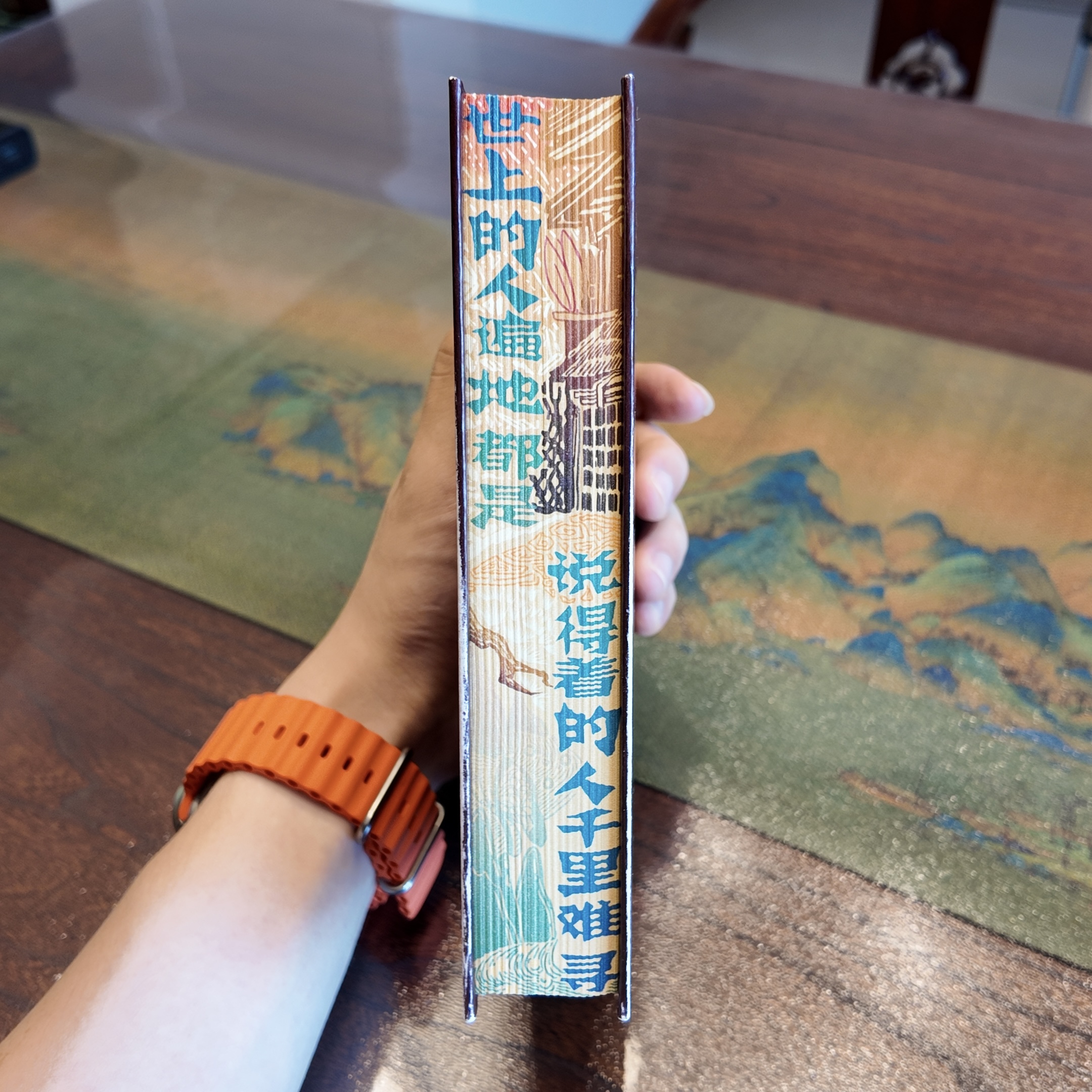
To live as a clear-eyed person, understand two things. First: the days you live are the days ahead, not the days behind. Second: the world is full of people everywhere, but someone you can truly talk to is a thousand-mile find.
Zhengyang Yao
Beijing, July 19, 2026